The most irritating issue for a homeowner may be plumbing. These plumbing tips may lead to high costs and inconvenience because they can be caused by a leaky tap or a burst pipe. The good thing is however, that you need not wait till a disaster has struck. These are most of the problems that could be prevented with some care and attention.
In this case, we shall introduce some easy and convenient preventative plumbing tips that would save you both time and money as well as help you to avoid a lot of stress.
Even the small amount of leakage can turn into a big problem in case it is not handled. It might not seem to be a drip in the ocean, but over time, water can cause damage, mold and even a structural damage which could make you spend hundreds or even thousands of dollars to fix.
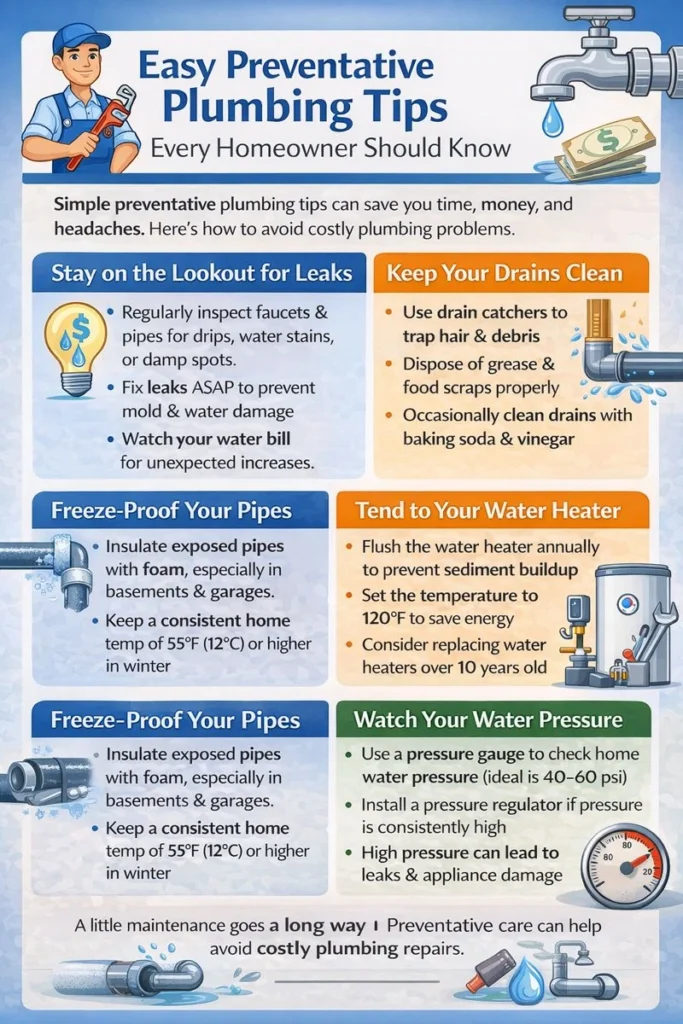
Ensure that you inspect your faucets, showerheads and your sink pipes. Just in case you will discover any traces of water pools or damp spots then repair them as soon as possible. You are also able to monitor your water bill in case there are any strange peaks in your water bill, the abrupt increase could be an indication of some undetected water leak in your house.
The other plumbing issue that can lead to a lot of headaches concerns the blocked drains. Hair, grease, soap scum, all this may build up over time and lead to the slowing or total clogging of your drains. A clogged drainage can impose a significant burden on your drainage system and expensive repair to the same, unless the issue is addressed.
Not to block the drainage systems, do not pour grease or food scraps in the drain of the kitchen and never pour the hair or any other debris in your bathroom sinks without drain catchers. Occasionally, it is good to clean your drains using natural baking soda and vinegar to make sure that it flows.
Pipes that are frozen is a matter of concern in case of lower climate. The freezing water in pipes also expands and this can result in bursting of pipes. This has the potential of making the water damages, expensive repair and even replacing the pipes.
It is advisable to insulate all the exposed pipes, in any unheated area of the basement or garage, in the colder months. Your pipes will remain free of freezing by using foam pipe insulation or even by heating up a piece of tape. The next one is, when colder keep cabinets doors open under sinks allowing warm air to move around the pipes.
Water heater is a significant item of your plumbing system but people never pay much attention to it. Eventually, sediment can build up in the tank and make the tank inefficient besides the fact that it can lead to a failure. You will now be taking cold showers and paying a high bill to replace a broken water heater.
It is possible to empty the water heater once a year and that will keep it efficient. That you should also do is to check the temperature setting; the temperature must be adjusted to 120degF (49degC) which will conserve the amount of energy used and the unit will have an extended lifespan. A water heater with minor evidence of wear over 10 years old may just be something worth replacing before they stop functioning.
This may not be a bad thing, but it will, at least, lead your plumbing system to bear a significant amount of stress should the pressure of the water be very high. Leakages or the burst of pipes and the destruction of appliances including the dishwasher and the washing machine could occur because of the overpressure.
The pressure of water can easily be measured using a pressure gauge that is easily available at the nearest hardware store. Home should have optimum pressure of 40-60 psi. When you are always under pressure that exceeds such, you can install a pressure regulator to ensure that everything is within reach.
Homeowners can save on time and money in the event of simple plumbing maintenance. Leaks, clean drains, checking of pipes and water pressure are to be ensured regularly to avoid significant problems. To seek professional advice and plumbing services of an expert, go to Fisher Family Plumbing to maintain the plumbing of your house.
The entire principle of preventative plumbing is being proactive. Simplified steps that you can implement include checking on leakages, cleaning your drainage, insulating your pipes, keeping your water heater and checking on your water pressure which will save a lot of costly plumbing troubles ahead. Moreover, you will be comfortable knowing that the plumbing of your house is well maintained.
How often are the leaks in the plumbing checked?
You, can also consider checking the leaking in the plumbing system at least every 3-6 months, and it is at this time that there is a possibility of leakage at the faucet and shower head as well as under sink areas.
But what do we do to prevent the clogging of drains?
Trap hair and debris using drain catchers, never pour grease and oil down the drain and clean your drains using natural cleaners like baking soda and vinegar.
How do I make sure that my pipes are not frozen in winter?
Insulate your exposed pipes using foam insulation or heating tapes and at least the thermostat in your house to 55degF (12degC) during winter so that your pipes do not freeze.
How can I tell when my water heater needs service or not?
Probably when it is making weird sounds, does not supply hot water frequently or has rusty look, then it might be time to decontaminate the tank or replace it.
How do you do it to check the pressure of my water?
To gauge the water pressure in your house, you can purchase a water pressure gauge in most of the hardware stores. It should be a pressure of 40-60 psi.