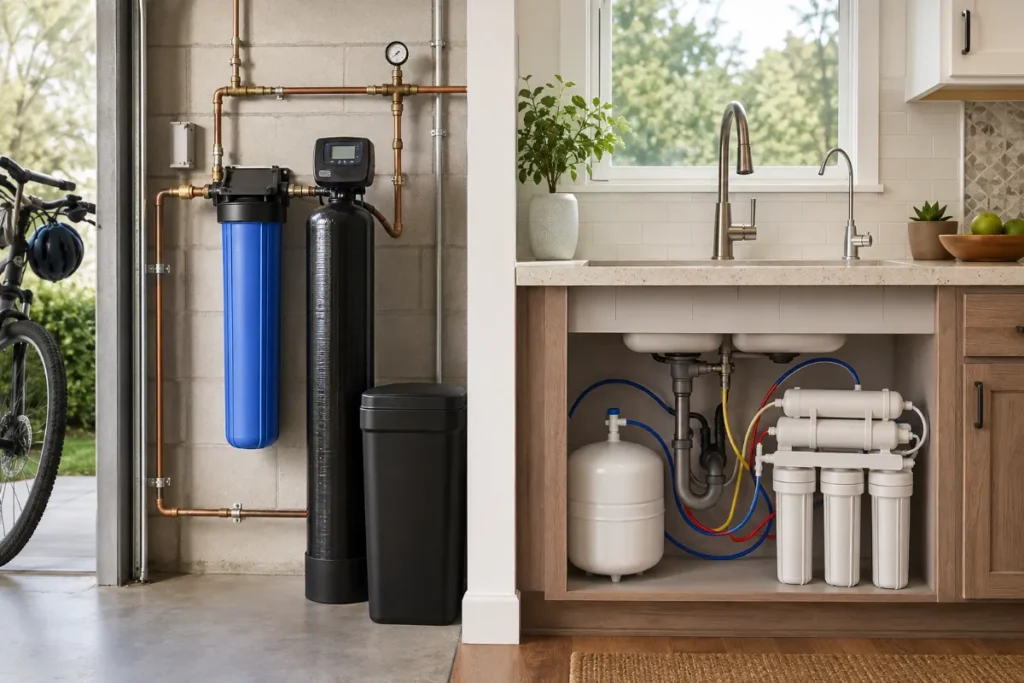
Whole-house water filtration and reverse osmosis usually solve different water-treatment goals. A whole-house system treats water as it enters the home so multiple fixtures receive treated water. Reverse osmosis, or RO, is commonly installed at a single fixture, such as the kitchen sink, where it provides more targeted treatment for drinking and cooking water.
If your concern affects showers, sinks, laundry, and other fixtures throughout the house, whole-house water filtration may be the better starting point. If the main priority is drinking and cooking water, reverse osmosis may be more appropriate. Some homes use both.
The right choice depends on the actual water concern, the treatment technology used, and the performance claims of the specific equipment.
What Is the Main Difference Between Whole-House Filtration and Reverse Osmosis?
The simplest difference is where the water is treated.
Whole-house filtration treats water before it reaches multiple fixtures
A whole-house system is generally installed on the incoming water line. Water passes through the treatment system before traveling to fixtures throughout the home.
Depending on the system, treated water may then be supplied to:
- Kitchen and bathroom faucets
- Showers and tubs
- Toilets
- Washing machines
- Dishwashers
- Water heaters
- Other connected fixtures and appliances
The type of filtration media determines what the system is designed to reduce. A sediment filter, carbon filter, and specialty treatment system do not all perform the same job.
Homeowners interested in broader treatment can review Fisher Family Plumbing’s residential water filtration services.
Reverse osmosis usually treats water at one fixture
Point-of-use RO systems are commonly installed beneath a kitchen sink and connected to a dedicated drinking-water faucet. EPA defines point-of-use RO systems as systems used to treat drinking or cooking water at a single tap.
Depending on the installation, an RO system may also be connected to a refrigerator or ice maker, but that capability depends on the system and plumbing configuration.
Homeowners primarily concerned about drinking and cooking water can learn more about residential reverse osmosis systems.
What Does a Whole-House Water Filter Actually Do?
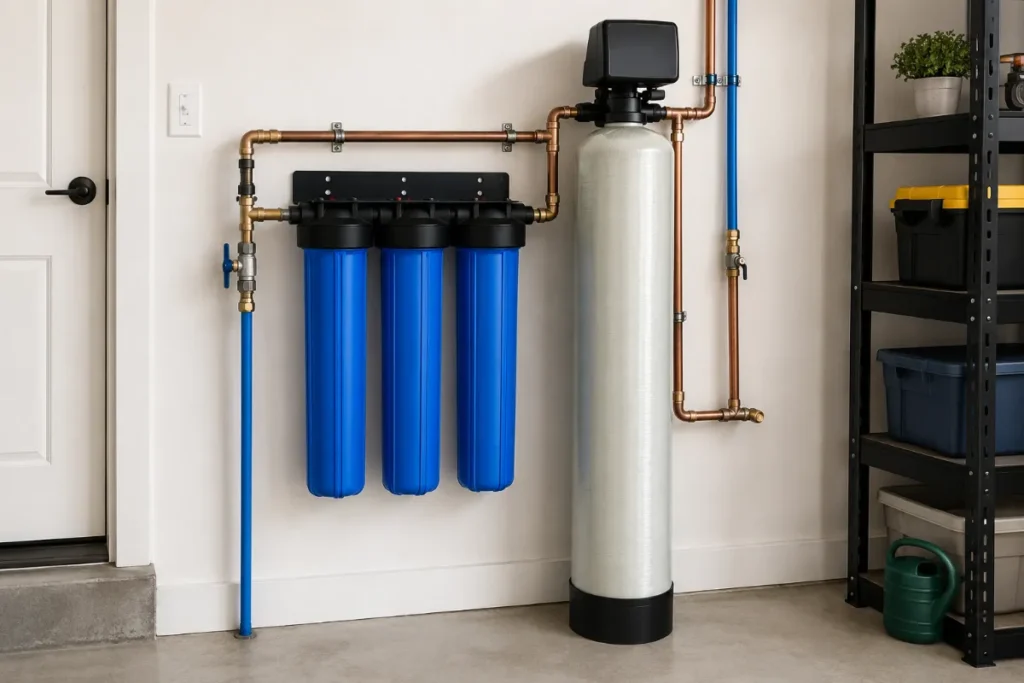
There is no single type of whole-house filter.
The treatment method should be selected based on the water-quality issue the homeowner wants to address.
Sediment filtration
Sediment filters are designed to capture suspended particles such as sand, dirt, rust, or other particulate matter.
They may be useful when a homeowner notices visible sediment or when sediment needs to be reduced before water reaches other treatment equipment.
Carbon and other filtration media
Carbon-based filtration is commonly used to address certain taste and odor concerns and may reduce particular chemicals depending on the specific product and certification.
Other media may be designed for different water-quality concerns.
The important point is that the words “whole-house filter” do not tell you exactly what the system removes.
NSF explains that manufacturers select specific contaminant-reduction claims for their products, and certification verifies those particular claims.
What whole-house filtration may not address
A standard whole-house filter should not automatically be assumed to:
- Remove every dissolved substance
- Eliminate hardness
- Remove every microorganism
- Remove every heavy metal
- Make contaminated water safe
- Solve every taste, odor, or staining problem
Treatment needs to match the actual condition and the capabilities of the equipment.
What Does Reverse Osmosis Do?
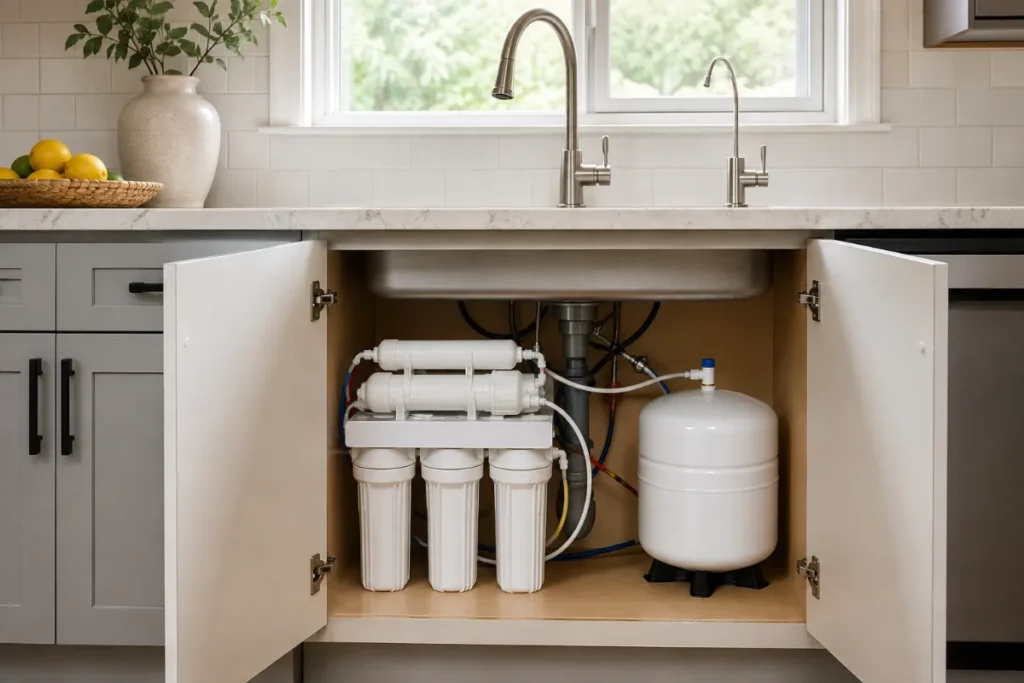
Reverse osmosis uses pressure to move water through a semipermeable membrane. The process separates treated water from a stream containing substances rejected by the membrane.
Most residential RO systems also use additional filters before or after the membrane. NSF notes that RO systems commonly incorporate one or more additional filtration stages around the membrane.
What can reverse osmosis reduce?
RO can reduce a range of dissolved substances, but the exact performance varies by system.
CDC notes that RO systems may reduce substances including lead, copper, chromium, chloride, sodium, arsenic, fluoride, sulfate, calcium, magnesium, nitrate, and others. CDC also advises checking the filter label for the specific substances the product is designed to reduce.
That distinction matters.
Do not assume that every RO system removes every contaminant simply because it uses reverse osmosis technology.
Why is RO commonly used for drinking water?
RO is often used at the kitchen because homeowners typically want more targeted treatment for:
- Drinking water
- Cooking water
- Coffee or tea preparation
- Refrigerator water
- Ice, when properly connected
A point-of-use system can concentrate more specialized treatment at the fixture where that water is actually consumed.
Whole-House Water Filtration vs. Reverse Osmosis: Side-by-Side
| Factor | Whole-House Filtration | Reverse Osmosis |
| Typical location | Incoming water line | Usually one fixture |
| Water treated | Multiple fixtures throughout the home | Typically drinking and cooking water |
| Main purpose | Broader household treatment | More targeted treatment |
| Technology | Varies by system | Membrane plus additional filters |
| Space required | Utility, garage, or plumbing area | Often beneath a sink |
| Maintenance | Filter or media replacement | Filters and membrane replacement |
| Reject water | Depends on treatment method | Yes |
| Hardness treatment | Only if specifically designed for it | May reduce hardness minerals at the treated fixture |
| Can it work with another system? | Yes | Yes |
Neither column is automatically “better.” The right choice depends on what you want the water treatment system to accomplish.
Which System Is Better for Taste and Odor?
Either may help, depending on the cause.
A whole-house carbon-based system may be useful when taste or odor affects water throughout the home. An RO system may also improve drinking-water taste because many RO systems include carbon filtration before or after the membrane.
However, taste and odor alone do not identify the underlying cause.
A chlorine-like smell, sulfur-like odor, metallic taste, or musty taste can have different explanations. Treatment should not be selected solely from a description of the smell.
When a specific contaminant is suspected, testing or current utility water-quality information is more useful than guessing.
Which System Is Better for Hard Water and Scale?
Whole-house filtration and water softening are not automatically the same thing.
A standard filter may remove sediment or address certain taste and odor issues without removing the calcium and magnesium associated with hardness.
A water softener uses a different treatment process specifically designed to address hardness minerals.
Can RO reduce hardness minerals?
RO can reduce calcium and magnesium in the water it treats. CDC includes both among substances that RO may reduce.
But an under-sink RO system only treats water at that point of use.
It does not soften:
- Shower water
- Laundry water
- Water entering the water heater
- Other faucets throughout the home
If hardness is a whole-home concern, a point-of-use RO system alone does not address the rest of the plumbing system.
For more detail, homeowners can review Fisher Family Plumbing’s existing information about hard-water problems and household plumbing, using the current canonical hard-water article URL when implemented.
Can You Use Whole-House Filtration and Reverse Osmosis Together?
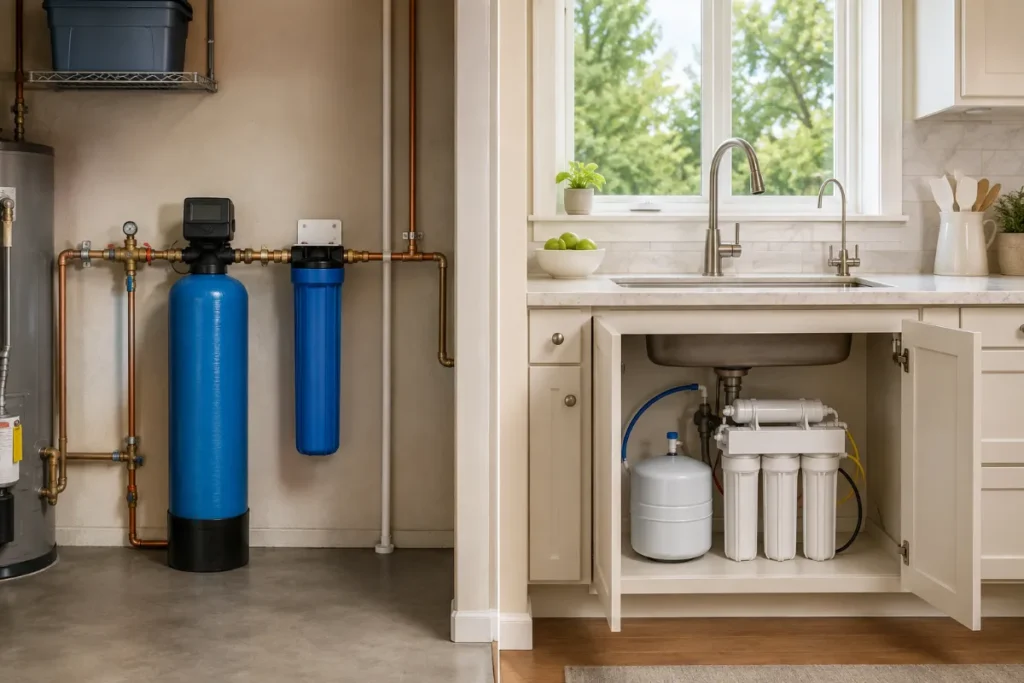
Yes. Whole-house filtration and RO can complement each other because they typically treat water at different points.
A common arrangement is:
- Water enters the home and passes through the whole-house filtration system.
- Treated water is distributed throughout the plumbing system.
- Water at the kitchen passes through a separate RO system before reaching the drinking-water faucet.
This gives homeowners broader treatment throughout the house while adding more targeted treatment where drinking and cooking water are used.
Fisher Family Plumbing’s current service information presents whole-home filtration and reverse osmosis as options that can be used together, depending on the homeowner’s goals.
That does not mean every home needs both.
Should You Test Your Water Before Choosing a System?
Testing is especially important when you are trying to address a specific contaminant rather than a general taste, odor, or sediment concern.
CDC recommends choosing a treatment system based on the germs or chemicals you are concerned about rather than assuming every filter removes everything.
If you receive municipal water
Look for your water provider’s current Consumer Confidence Report or other published water-quality information.
The report may help identify:
- The source of the water
- Substances tested
- Current test results
- Applicable regulatory limits
- Treatment performed by the utility
Spring-area homeowners may be served by different utilities or municipal utility districts, so one report should not be applied to every property.
If you use a private well
Private-well owners are responsible for monitoring their own water quality. Testing becomes especially important before selecting treatment for a suspected contaminant.
Do not assume a particular whole-house or RO system is appropriate until the water concern is identified.
What Do NSF Certifications Mean?
Certifications help homeowners determine what a specific product has actually been tested to do.
Common standards include:
NSF/ANSI 42
Generally associated with aesthetic effects such as certain taste, odor, and chlorine-reduction claims.
NSF/ANSI 53
Used for certain health-related contaminant-reduction claims.
NSF/ANSI 58
Applies specifically to point-of-use reverse osmosis drinking-water treatment systems. NSF describes NSF/ANSI 58 as the standard covering point-of-use RO systems and their performance requirements.
Certification to a standard does not necessarily mean the system reduces every substance covered by that standard.
Check the individual product’s certified reduction claims.
How Much Maintenance Do Whole-House Filters and RO Systems Need?
Both require ongoing maintenance.
Whole-house filtration maintenance
Depending on the equipment, maintenance may involve:
- Replacing filter cartridges
- Replacing or servicing treatment media
- Inspecting housings and connections
- Monitoring water pressure
- Checking for changes in treatment performance
There is no universal replacement schedule. Water conditions, household use, filter capacity, and equipment design all affect service intervals.
Reverse osmosis maintenance
RO systems may require:
- Prefilter replacement
- Postfilter replacement
- Membrane replacement
- Tank or faucet inspection
- Connection checks
- Periodic servicing according to manufacturer requirements
EPA notes that continued RO effectiveness depends on proper maintenance and replacement of membranes and filters.
Ignoring maintenance can reduce system performance.
Does Reverse Osmosis Waste Water?
RO creates a reject-water stream as part of the treatment process.
Not all incoming water becomes drinking water. Some water carries the substances rejected by the membrane to the drain.
Efficiency varies significantly among systems.
EPA created WaterSense criteria for point-of-use RO systems to identify models that meet current efficiency and performance requirements. WaterSense-labeled products are independently certified to meet EPA specifications.
This makes water efficiency a useful factor to compare when selecting an RO system.
Avoid assuming all RO systems use the same amount of water.
How Do You Choose Between Whole-House Filtration and Reverse Osmosis?
Start with one question:
Where do you want the water treated?
Whole-house filtration may be the better starting point when:
- Water concerns affect several fixtures
- Sediment is noticeable throughout the home
- Taste or odor problems occur at multiple faucets
- Shower, laundry, and appliance water are part of the concern
- You want broader treatment before water is distributed throughout the house
Reverse osmosis may be the better starting point when:
- Drinking water is the primary concern
- Cooking water is the primary concern
- Treatment is only needed at one fixture
- A certified RO system addresses the specific substance you want reduced
- You want a dedicated drinking-water faucet
Consider both when:
- You want broader treatment throughout the home
- You also want more targeted treatment for drinking and cooking water
The correct system is not determined by which technology sounds more advanced. It depends on what is in the water, where treatment is needed, and what the selected equipment is certified to reduce.
Water Filtration and Reverse Osmosis in Spring, Texas
Homeowners comparing treatment options do not have to choose based on product labels alone.
Fisher Family Plumbing provides whole-house and residential water filtration as well as reverse osmosis system installation for Spring and surrounding communities.
The best starting point is identifying the concern you want the system to address and whether you want treated water throughout the home or primarily at the kitchen.
Call (832) 844-7200 or request a quote and schedule a consultation to discuss your home and water-treatment goals.
Frequently Asked Questions
Do I need reverse osmosis if I already have a whole-house filter?
Not necessarily. A whole-house system may already address the concerns that matter to you. RO may be useful when you want additional treatment specifically for drinking and cooking water or when a certified RO system addresses a particular substance that the whole-house system does not.
Does a whole-house water filter remove hard water?
Not automatically. Hard-water treatment depends on the technology used. A standard sediment or carbon filter should not be assumed to soften water. Whole-home hardness problems are generally addressed with equipment specifically designed for hardness reduction.
Does reverse osmosis remove everything from drinking water?
No. RO can reduce many substances, but performance varies among products. Check the system’s certification and contaminant-reduction claims rather than assuming that every RO unit removes everything.
Can an RO system connect to a refrigerator or ice maker?
Some residential RO systems can be connected to refrigerators or ice makers when the equipment and plumbing configuration allow it. Fisher Family Plumbing should confirm this capability for the systems it installs before it is promoted as a standard option.
Should I test my water before installing a filtration system?
Testing is particularly useful when you are concerned about a specific contaminant. Municipal-water customers can also review their provider’s current water-quality report. The goal is to choose treatment based on the actual concern rather than guessing from appearance, taste, or odor alone.
Can whole-house filtration and a water softener be used together?
Yes, depending on the equipment and water conditions. Filtration and softening perform different functions, so some homes use both. Fisher Family Plumbing’s exact water-softener service and installation capabilities should be confirmed before this is presented as a company offering.
External Sources
U.S. Environmental Protection Agency
Point-of-Use Reverse Osmosis Systems
Used to verify how point-of-use RO systems are defined, how reject water relates to RO operation, and how WaterSense identifies more water-efficient systems.
WaterSense Guide to Selecting Water Treatment Systems
Used for general water-treatment selection and RO efficiency considerations.
Centers for Disease Control and Prevention
About Home Water Treatment Systems
Used to verify how reverse osmosis works and why treatment methods should be selected based on the substances of concern.
About Choosing Home Water Filters
Used to verify that RO may reduce specific dissolved substances and that homeowners should check product labels for specific reduction claims.
NSF
NSF Standards for Water Treatment Systems
Used to verify the roles of NSF/ANSI standards and the importance of product-specific contaminant-reduction claims.
NSF/ANSI 58: Reverse Osmosis Drinking Water Treatment Systems
Used to verify that NSF/ANSI 58 applies to point-of-use reverse-osmosis drinking-water treatment systems.